What is a fractal, anyway?
A shape that grows from a simple rule applied to itself over and over. In 3D, that produces structures reminiscent of coral, cathedrals, or alien planets – and the closer you fly, the more detail appears. You don't write those rules yourself: you pick formulas, combine them, and see the result instantly.
Do I need math or 3D skills?
No. You work with sliders for shape, color, light, and surface, and fly through your scene with mouse and keyboard. The easiest start is an existing scene and a single slider. Curiosity matters more than background knowledge.
What do I need?
A desktop, laptop, or larger tablet with a current browser – ideally Chrome or Edge. There is nothing to install; images are created right on your device using its graphics hardware. On a phone you can view works, but not create them.
How is this different from Mandelbulb 3D, Mandelbulber, and other desktop apps?
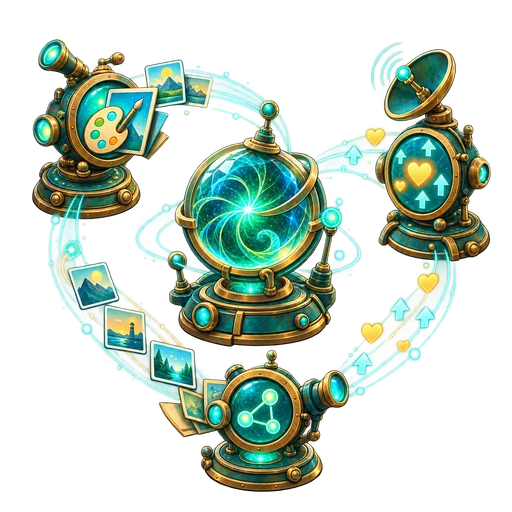
Those are great programs – your work lives there as files on your disk. Mandelcloud runs in the browser with a smooth real-time preview and takes your work online: scenes live in your cloud Diary, you publish to a community with profiles, comments, and Staff Picks, and shared scenes can be remixed. Who built on whose work stays visible automatically.
What does it cost?
Getting started is free and needs no credit card. Paid plans add publishing, higher-resolution videos with no fixed length limit, more cloud storage, and more.
Other fractal tools are free – why would I pay?
Mandelcloud renders images on your device, and the Free plan stays free. Everything that lives online, though, has ongoing costs: servers, storage for scenes and images, bandwidth for the community, backups, security, moderation, and continuous development of new formulas and features. Mandelcloud shows no ads and uses no tracking – subscriptions pay for exactly that.